Complete Guide To Buying A Snowboard 2022
Jan 28, 2022
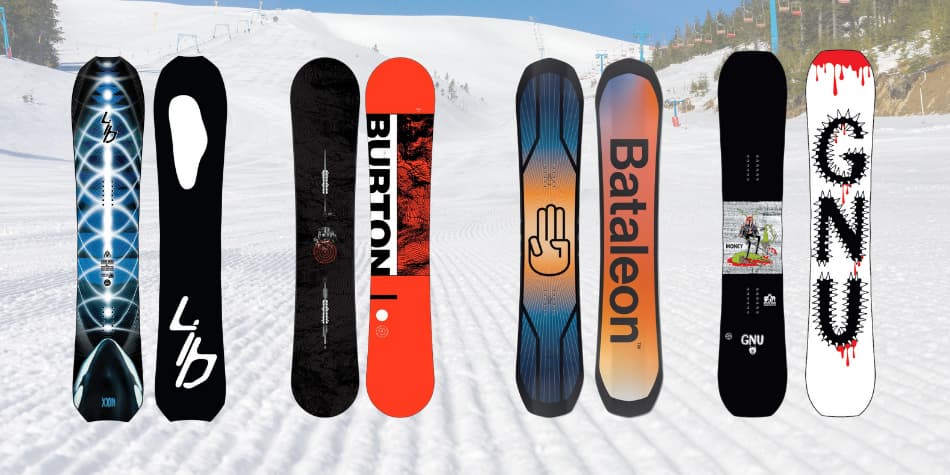
Simplybuy was built to be the absolute best tool for anyone - newbie or professional alike - to select their new gear. We’ve always followed the KISS (keep it simple, stupid!) model and have prioritized keeping our custom PSGs (product selection guides) to 3 minutes or less and letting our AI do the rest of the heavy lifting. But for those who really want to dive into the deep and learn everything there is to know about their future snowboard before making a purchase, this post is for you. We’ll go through each step of the guide in detail to help ease your mind that you are buying the absolute perfect board for you. Let’s get started.
Gender
There are differences between men's and women's boards other than the graphic designs. Women’s boards are made for lighter riders with smaller feet. Thus they are narrower and more flexible than boards made for men. We generally recommend that men ride boards made for men and women ride boards made for women but there are exceptions. The most common being that larger women are often better suited riding a “mens” board. Our sizing calculator will automatically recommend switching to men's boards if you are a woman that fits into this exception.Ability Level
There are snowboards designed for every ability level. Typically beginner snowboards are less expensive and are more forgiving for new riders. On the other end, snowboards for advanced and expert riders will usually cost more because of the advanced features which cater to the skilled riders.Beginner
From those that have never snowboarded to those that are able to slide left and right in control on both edges on green terrain.Intermediate
Not new to snowboarding but also not the most skilled rider on the mountain. You are able to string together turns with minimal traverse comfortably on all blue terrain and easy black runs.Advanced
Can handle pretty much all runs. You are able to make turns with rhythm and flow on black runs.Expert
You know who you are and you can handle anything the mountain throws at you.Snowboard Type
Back in the day, snowboards were basically all the same. A thin slice of wood with metal edges. This was ok for getting down a reasonably steep slope, and that was about it. Thankfully, nowadays we have snowboards specially designed for all sorts of different purposes. We group them into 5 different categories. All mountain, freestyle, freeride, powder, and split.All Mountain
Designed to work well in all terrains and snow conditions. They are very versatile snowboards and will be able to handle anything the mountain throws at it. Best bet for most riders.Freestyle
Designed specifically for terrain parks and those who perform tricks. Freestyle boards are generally twin-tipped and made to be ridden in the center of the board or very close to it. This is ideal for landing backwards or “switch” after performing a 180 or 540 (or 900!). If you spend any significant time in “the park” we recommend a freestyle board as it will generally perform better on the rest of the mountain than other board types will perform in the park.Freeride
Designed to be taken off the groomers and onto diverse terrain. Typically they are stiffer, longer boards. If you are frequently going out of bounds or getting into backcountry that doesn’t quite warrant a powder board, freeride might be the best fit. Freeride boards will do well in powder while still performing far better on groomers than a pure powder board would.Powder Boards
Designed to thrive in powder. Ideal pick for backcountry, helicopter or powder-cat snowboarding. If you are lucky enough to get significant powder days, there is no feeling like riding a proper powder board in 2 feet of the fresh stuff. But if you are riding a mixture of backcountry and resort, we’d recommend one of the other board types as the powder boards won’t perform great on groomers or in the park. If you can afford it, having a specialized powder board just for those special days of deep powder will make them all that much better.Splitboards
Designed for backcountry riders. Splitboards separate into two ski-like halves for uphill travel. Splitboarding is great, but these are the absolute least versatile boards and we’d never recommend a split board as a primary board for resort riding. Almost everyone who buys a split board already has a board or two of the other types.Snowboard Shapes
Asymmetrical
Asymmetrical boards are designed to accommodate for the differences in heel-side and toe side-cuts. They often have a deeper, shorter heel-side cutout relative to the board's toe-side cutout. In addition the flex of the board can be asymmetrical to make heel-side cuts easier for the rider. We think these boards can largely be a bit gimmicky and wouldn’t recommend them unless you know who you are and exactly what you are looking for.Directional
Designed mostly for Freeride and Powder boards. These boards will often have a longer and/or wider nose with a shorter and stiffer tail. The binding inserts will also be setback which is optimal for powder runs. The downside of directional boards is that they are very difficult to ride or land in the switch position so if you are doing lots of spins or just generally like the flexibility of riding with either foot forward the direction is not for you.Directional Twin
Versatile shape commonly found on All Mountain boards. The nose and tail will be mirror images of each other however the binding inserts are setback. Designed to be ridden forward but they can also handle being ridden switch. If you are only going to own one board and want to use it in all different types of terrain then a directional twin is likely your best choice.True Twin
The nose and tail are mirror images of each other and the binding inserts are centered. The board also has the same flex on both ends. Best bet for Freestyle snowboards and riders who like to ride switch a lot. If you spend a majority of your time in the terrain park then a true twin is likely the board shape for you.Volume Shifted
Short and wide profile. These boards push your weight to the back of the board which keeps the nose on top of the snow. Volume Shifted boards are alternative to the long powder boards and are more maneuverable for tree runs. They are made for backcountry and deep powder days. Most riders buying a volume shifted board already have a more “everyday” board and will reserve the volume shifted board for special backcountry powder days.Snowboard Sizes
Getting the right size board can mean the difference between floating blissfully down the mountain and feeling like a freight train without brakes. Our algorithm uses your height, weight, shoe size, and answers from the previous questions to determine your size ranges. Similar to snowboard type and shape, there are tradeoffs to be made when selecting a board size. In a perfect world we would ride a long directional board as we cruise down the groomer and then have it morph into a shorter volume shifted board as we enter a patch of powdery trees, only to morph again into a mid length twin tip as we launch a 360 off a kicker to finish our run. Unfortunately here in reality our boards stay the same size and shape all day so we need to find the best size to accommodate most situations we’ll find ourselves in. Shorter boards are more maneuverable and lighter making them easier to spin and turn. Longer boards are more stable at high speeds and float better in powder. Boards made for larger riders are also a good bit wider in order to accommodate larger boot sizes. A size 12 boot on a normal to narrow waisted board will result in the toe or heel (or both) of your binding dragging on the snow when carving. A surefire way to ruin your day.Snowboard Base
Extruded
Less expensive and more durable option. However, extruded bases do not hold wax as well and therefore is a much slower base compared to a well-maintained sintered base. There are really only 2 reasons to get an extruded base. 1: Sintered base boards are out of your budget. Or 2: You know that you are going to be too lazy to properly maintain your board.Sintered
When waxed and maintained properly sintered bases are much faster than extruded bases making it the ideal base for almost all riders. Get a sintered base, take good care of it, thank yourself later.Flex
Soft
Ideal for Freestyle snowboards. Soft boards increase mobility for spins, tricks and butters. Soft boards can also be the right pick for beginners because they are easier to control and are more forgiving.Medium
Versatile flexibility. Can handle speed and carving while also enjoying some of the benefits of soft boards. Best bet for All-Mountain boards.Stiff & Very Stiff
For those that love to carve and speed. Typical on Freeride and Powder boards to make carving in deep powder easier. Riders who only ride one board should generally choose a medium or stiff board. Soft and very stiff boards are more specialized use cases in a similar way as volume shifted boards etc.Edge Tech
Magne-Traction is the most known name of these technologies but each brand has their own unique name. Edge tech increases contact points on the edge of the snowboard. The purpose of these extra contact points is to help the snowboard maintain its edge while cutting in icy conditions. Snowboards with edge tech are comparable to a serrated knife versus a butter knife. We generally recommend most people select a board with edge tech because the worst case is that you don’t even notice it as you glide through the powder but the best case is it saves your day when you encounter an unexpected patch of ice. It is not a necessity but it’s a nice feature to have.Camber Profile
The Camber Profile is the shape of the board when looking down the side. Camber is a convex shape while Rocker is a concave shape. Boards can also be hybrids of Rocker, Camber, and flat. The best pick for you can depend on your snowboard type, ability level and desired feel. This is a lot of information to take in - but don’t worry if you aren’t feeling confident about what to choose here. Just select “any” and let our AI do the work for you based on your responses to the rest of the questions.Rocker
Playful feel, initiates turns easily, great for butters, and floats well in powder. However there is less pop and doesn't hold an edge as well compared to Camber boards. Great for beginners who aren’t as worried about performance at very high speeds.Camber
Provides good pop for ollies and jumps, improves edge-hold, adds to spring out of a turn and helps with stability at speed. However it is not ideal in powder due to needing to lean back further to keep the nose out of the snow. Also not ideal for beginners who have trouble “catching” an edge when carving.Rocker/Camber
A directional blend of rocker and camber. Typically adds stability and float in the front while giving added power and control in the back.Rocker/Camber/Rocker
Initiates turns well and floats in powder, while the center camber adds stability, pop, speed and increased edge-hold. Great pick for beginners.Camber/Rocker/Camber
Looser feel and better float in powder than a traditional camber board. Also is easier to initiate turns. It will butter well and land well. This is a great all round profile for the Freestyle and All-Mountain boardsRocker/Flat/Rocker
More effective edge than pure Rocker which improves stability at speed. However this profile still retains the catch-free, floaty ride that the Rocker profile provides.Brands
We generally advise only using brand name as a tiebreaker if two boards both equally meet the rest of your criteria. There are top trusted brands that have wide ranges of boards (and other products) such as Burton Arbor, and Lib Tech. And there are brands that specialize in a certain category, such a Jones for backcountry powder boards. In any event, picking a brand really comes down to personal preference, and we are confident that you will be happy with the quality of any brand of board we recommend.
Congratulations! If you’ve made it this far, you are more than ready to select the perfect board. With a little help from our trusty AI of course. And remember, when in doubt, select all options that you think *might* be a fit for you and let us do the rest!
Ready for a personalized match? Try the Snowboard Picker — free recommendations in a couple of minutes.
Product Pickers
Jump To